Instagram is by far my favorite social media outlet. I shamelessly could sit there for hours following tags, searching for new wellness accounts to follow, and seeing what people are up to. But the thing that always grabs my attention are the Instagram Stories. To me, they are by far the most engaging and intriguing part of Instagram.
Instagram Stories are a huge viewer engagement opportunity. They add a personal level that truly grabs your followers’ attention.
Involving your Audience
There are so many tools you can use on Instagram Stories to make your audience feel like they are a part of your journey or your daily life. Here are the top engaging tools that you can use to engage your viewers:
Poll
Ask me a Question
Countdowns
Swipe Up
Each of these tools either ask for an action step from your followers such as responding with a question of their own or giving you their opinion, or they encourage your followers to check back for the post/event that the countdown was for.
Poll
Poll is by far, my personal favorite when following stories. It gives me a chance to feel involved in the person’s post. Polls are great for hearing what your viewers want to see. Use polls to give options to them and see what they are interested in listening to. This will encourage them to continue following you and checking in for the content they feel they had a say in. As health professionals, there are so many topics to talk about so see what information is being asked for.
Ask a Question
This is a great tool for health and wellness companies. Most people that are interested in health have questions and if they are following you, they are interested in what you have to say. A trend right now for fitness/health professionals is a Q&A session via IG Stories using the “ask a question” feature. Set up a time to have your followers ask questions, post their questions in your stories and address their questions during the videos. This involves the person asking the question and gives your viewers answers to questions they may have as well. During these sessions, utilize hashtags and tags to increase engagement and give the viewers something to follow up on after your session is complete. You can also create the label for the question meaning you can dictate what direction you want the questions to go. This will keep the conversation and videos you make focused on your specialties.
Countdowns
The Countdown feature can be great for creating excitement for an upcoming event, product release, or follow up post. Blogs are great to use countdowns for as well. It creates a buzz about your content and with the help of another feature (see below), you can have the follow up post lead directly to your blog.
Swipe Up
This can be one of the most useful and easy features in terms of marketing. The Swipe Up feature is used to take a viewer directly to a site that you would like them to see. You can increase website traffic, send your viewers directly to a post you want to highlight, or for healthcare professionals, send viewers to a scheduling system to get started utilizing your business. Consumers want easy ways to find information and we love social media. The Swipe Up feature address both of these aspects. Please note that to utilize the “Swipe Up” feature, you must have a minimum number of 10,000 on your business account.
Using Stories to Increase Website Traffic
By utilizing these features, you engage your viewers, give them a voice, provide information, and direct them to the next step. These features create an interactive environment and spike curiosity in your business. It may start just as another Instagram account for them to follow, but, if you keep providing top information that is sought after and provide an engaging environment, those followers may become future clients.
https://socialspeaknetwork.com/wp-content/uploads/2019/02/How-to-Use-Instagram-Stories-to-Engage-your-Health-Minded-Followers-1.png800800Amber Irwinhttps://socialspeaknetwork.com/wp-content/uploads/2018/04/SocialSpeak-Logo.pngAmber Irwin2019-02-19 08:00:062019-02-19 21:21:12Using Instagram Story Tools to Engage your Viewers
This blog breaks down the difference between a Content Marketing Strategy and a Content Plan. It then dives into National Observances that your team should consider integrating into its content or editorial calendar.
As we’ve worked with hundreds of businesses as they work with digital marketing to reach their business goals, we’ve found that more often than not there is a disconnect between what they are trying to accomplish and what actually gets done.
The reason?
A lack of planning for how to implement the content strategy causes content to be created in a vacuum. The content is not written to achieve a specific goal.
Originally I was going to write this blog to only focus on the difference between a Content Marketing Strategy and a Content Marketing Plan, but keeping your sights on external and national events is critical to participating as a relevant source of information in the digital world.
Let’s start by diving into a Content Marketing Strategy.
What is a Content Marketing Strategy?
A content marketing strategy is the Why behind the content you are creating. It includes identifying why your team is creating content, it is the vision you have for future content that is to be created.
This strategy should also identify who you are marking content for. Are some pieces of content designed specifically for prospects, referral partners, or clients? How can you differentiate between them? What are the goals of them? How will you position and use them online?
How to Create a Content Marketing Strategy
To start creating your Content Marketing Strategy, set your goals.
We recommend thinking first about the issues you may be facing as an organization and then set the goals as a way to solve these.
For example, we’ve worked with clients in the past who wished to use digital marketing to fill their schedule. After diving deeper, we recognized that they weren’t remarketing to or rebooking current clients as effectively as they could. As a way to capture low-hanging fruit, rather than creating content to educate and gain interest from folks whom had never heard of the client, we redesigned the content marketing strategy to focus on engaging with current and past clients.
Common goals of a Content Marketing Strategy include:
Increasing Revenue
Attracting leads
Lower costs
Better customers
Build an audience
Educate
Once you have identified a need in the organization and set a goal, it is easier to recognize alternative solutions to reach the goal.
Another aspect of the Content Strategy is identifying what tone you wish to take. For small businesses with only one or two content creators this can be easy. Do you speak in the first person, do you use past or present tense, are there branded keywords you should incorporate?
The last part of the content strategy is identifying which digital marketing networks to pursue and who to target on each network.
What is a Content Marketing Plan?
A content marketing plan is tactical – these are the actual steps you will take to implement the marketing strategy. In general, we never recommend creating a digital marketing content plan without first creating the strategy.
Why? You may realize after 6 months that the content you are creating has nothing to do with the goals you are trying to achieve!
We see this often with teams.
The director states that each week a blog needs to be written and at least 3 social media posts need to be published each week. However, the marketing experts creating the content don’t clearly understand how their piece fits in with the larger marketing strategy. What is the end goal of the content?
Key aspects to a Content Marketing Plan
The content marketing plan should include topics to cover, calls to action to include, specific promotions, who is responsible to creating various pieces of content, and how content will be published.
In our work, specifically the Roadmap to Digital Marketing, we recommend formatting the bulk of a content marketing plan like an editorial calendar.
An editorial calendar for digital marketing allows your team to easily see how content fits together and what topics should be talked about at certain times during the year (hence my inclusion of the National Observances list below).
Content Strategy and Content Marketing Working Together
As described above, a Content Strategy always comes first and the Content Marketing Plan is built based on the goals identified in the strategy.
One of my favorite examples of how a strategy and a plan work together is if an issue within an organization is that the close rate for new sales is lower than the industry average. The goal here may be to increase the close rate, boosting the bottom line.
After researching and surveying clients and prospects that decided to pursue another option, it becomes clear that the alternative tends to be a business with more name recognition.
How can content marketing help to shift the perspective and gain more trust? Here the strategy is to increase brand recognition and trust. The plan could be to create more videos with leadership and to incorporate blog posts that dive into company values.
This brings us to using relevant topics as a part of your marketing plan.
Being Relevant with your Content Marketing Increases the Effectiveness of your Digital Marketing Plan
If you are like 98% of our clients, one of the key goals identified in your content marketing strategy is to increase brand recognition and position your organization as an industry influencer.
Incorporating National Observances into your Marketing Plan is a key tactical decision your company can make to achieve this. Of course it is up to you and your team to decide which ones to highlight and how to incorporate them (podcasts, Instagram, Facebook, Youtube, promotions and sales, etc).
Some, such as New Years, Valentine’s Day, Mother’s Day, Father’s Day, the Fourth of July, Thanksgiving, and Christmas may all seem like obvious choices, but are they actually identified in a calendar?
Does someone on your team know that they are responsible for creating content 3-6 months in advance of these dates?
Then there are industry-specific days, weeks, and months. For example, if you are a health center and realize in February that it is American Heart Month, you are already late to the game.
You’ve missed the opportunity to reach new audiences by being a guest on a Podcast or having a guest blog post published in an industry journal.
Yes, you can still publish a last-minute blog to share on social media, but think of the opportunities you may have missed by not planning ahead.
National Observances to Consider for your Business
Here I’ve identified the top 3-5 National Observances for you to consider integrating into your marketing plan each month. The ones I’ve identified here are important, though some are a bit random. Our complete list of National Observances includes events for any type of business or industry.
Please enter your name and email for access to our full list of National Observances for 2019.
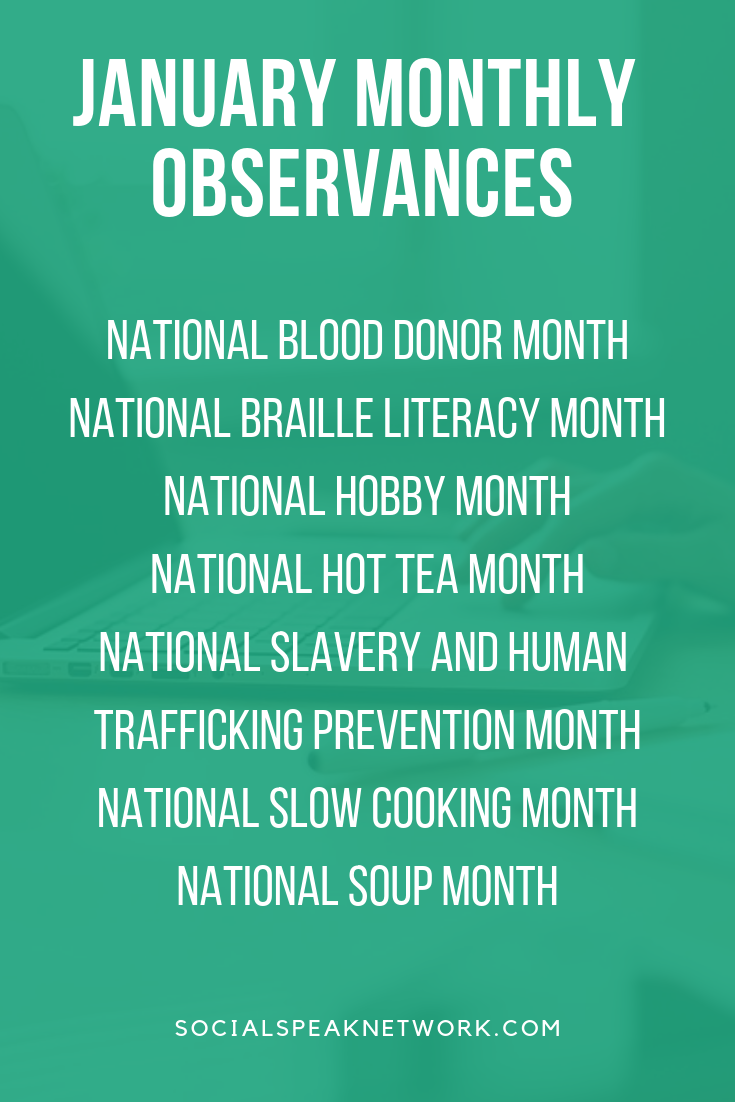
January Observances:
January 1: New Years Day
January 5: National Keto Day
January 24: National Compliment Day
3rd week in January: National Mocktail Week
National Blood Donor Month
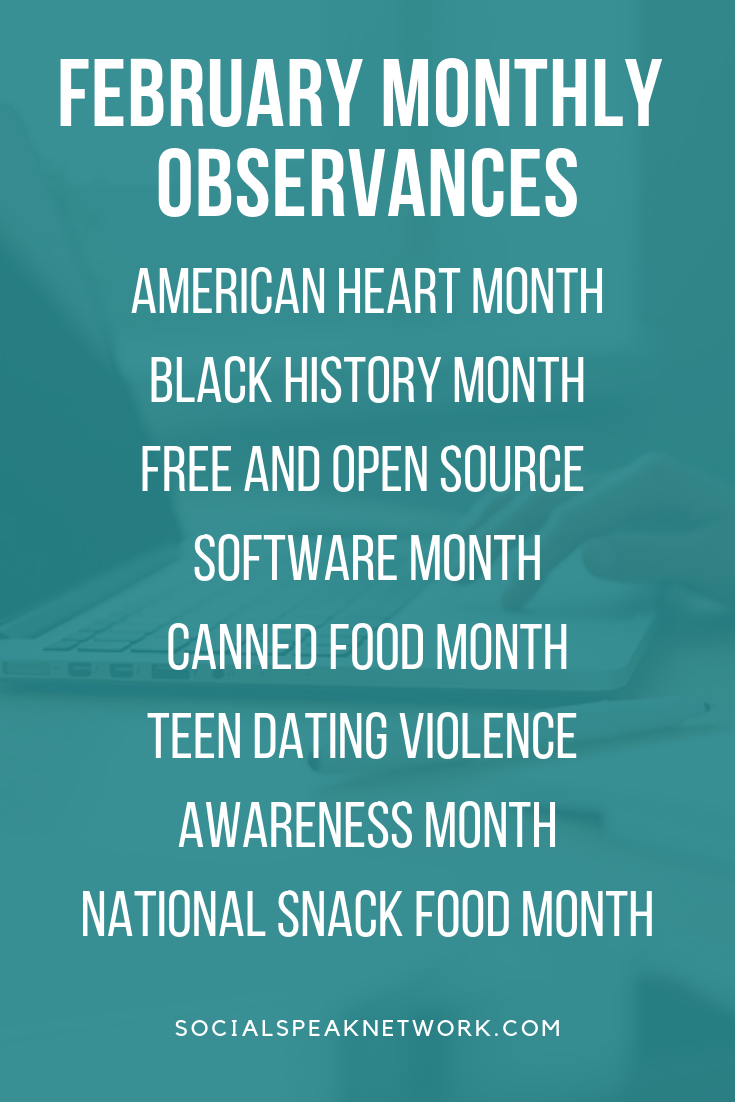
February Observances:
February 4: National Hemp Day
February 14: Valentine’s Day
February 22: National Margarita Day
American Heart Month
Black History Month
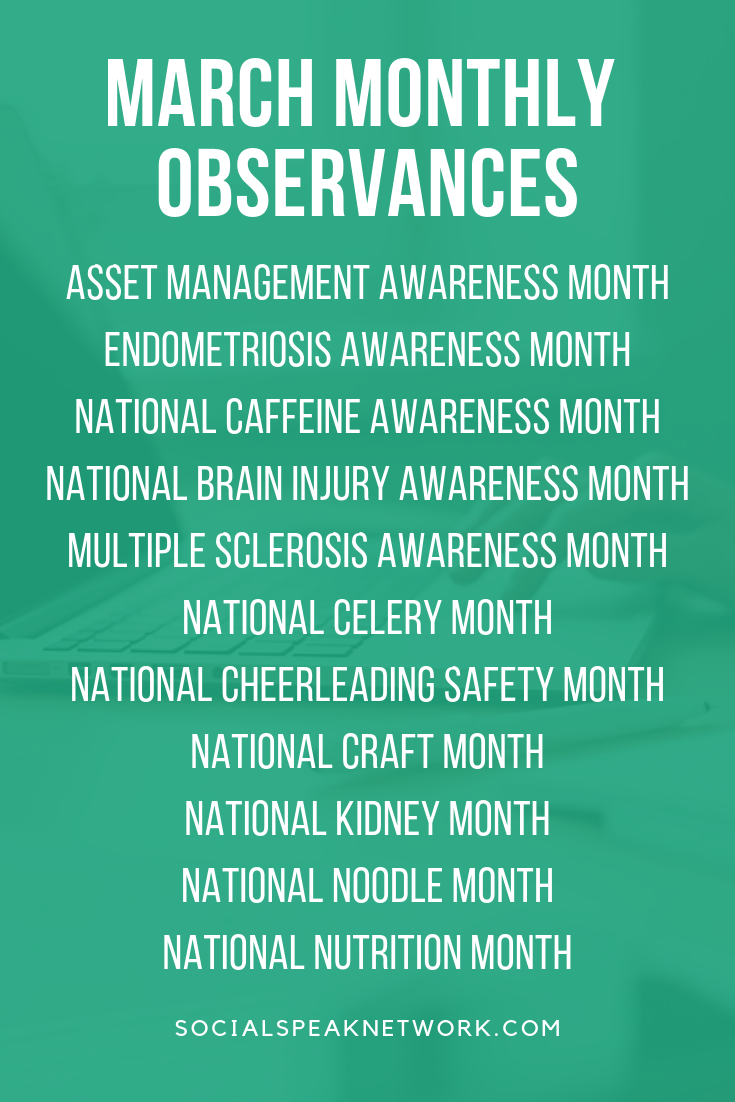
March Observances:
National Employee Appreciation Day – First Friday in March
March 14: National Pi Day
March 26: National Spinach Day
Endometriosis Awareness Week – (First full week – Monday through Sunday)
National Brain Injury Awareness Month
National Women’s History Month
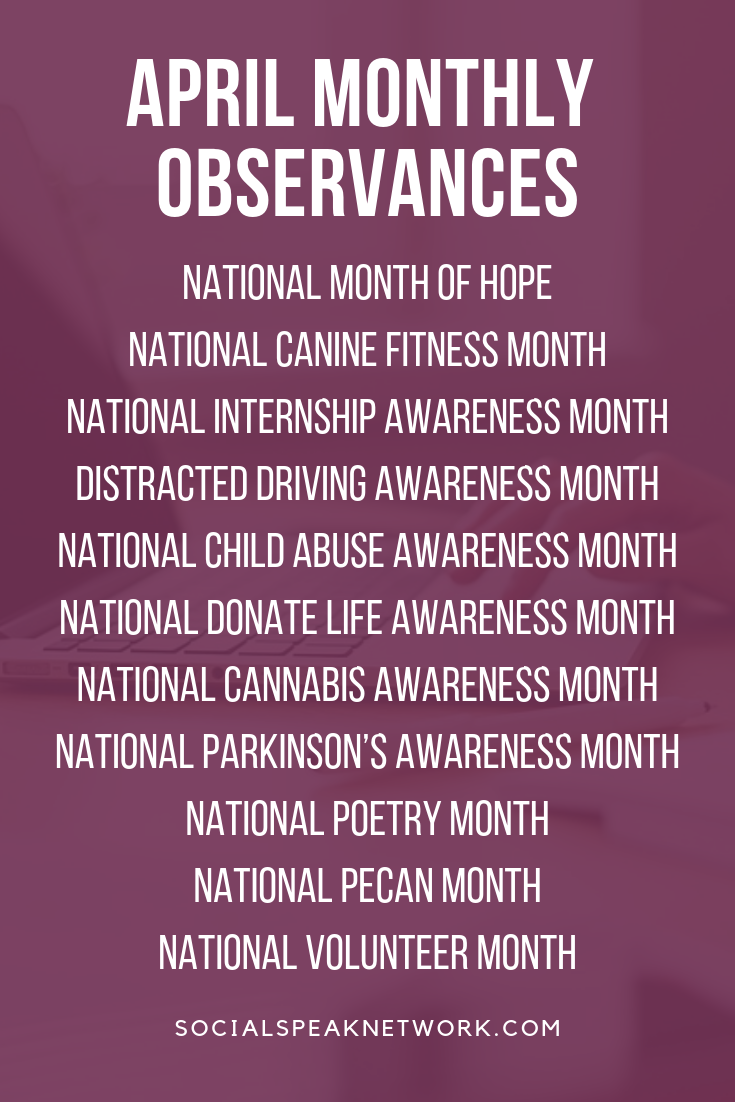
April Observances:
April 1: April Fools Day
April 8: National Zoo Lovers Day
April 21: Easter
National Child Abuse Awareness Month
National Parkinson’s Awareness Month
May Observances:
May 12: Mother’s Day
May 18: National HIV Vaccine Awareness Day
May 27: Memorial Day
Small Business Week – First Week in May
Celiac Disease Awareness Month
Melanoma Awareness Month
June Observances:
June 1: National Go Barefoot Day
June 12: National Peanut Butter Cookie Day
June 16: Father’s Day
LGBTQIA Pride Month
Men’s Health Month
July Observances:
July 4: Independence Day
July 12: National Simplicity Day
July 31: National Avocado Day
National Grilling Month
National Ice Cream Month
August Observances:
August 1: Respect for Parents Day
August 3: International Beer Day
August 19: National Soft Ice Cream Day
Simplify Your Life Week – First Week
Family Fun Month
September Observances:
September 2: Labor Day
September 8: National Suicide Prevention Month
September 13: National Kids Take over the Kitchen Day
September 30: National Chewing Gum Day
National Chewing Gum Day
National Suicide Prevention Month
October Observances:
October 28: National Chocolate Day
October 31: Halloween
Adopt A Shelter Dog Month
Breast Cancer Awareness Month
National Chiropractic Month
November Observances:
November 11: Veterans Day
November 22: Thanksgiving
November 24: Small Business Saturday
November 26: Cyber Monday
Adopt A Senior Pet Month
Gluten-Free Diet Awareness Month
National Alzheimer’s Disease Month
December Observances:
December 2: Chanukah
December 4: National Cookie Day
December 21: Winter Solstice
December 25: Christmas
National Human Rights Month
National Tie Month
As you build out your Digital Marketing Plan, we recommend downloading our complete list of National Observances. Start by deleting any cells or events that don’t apply to your business. Be sure, however, to think outside of the box.
Could you celebrate National Chocolate Chip Cookie day with the office?
Does anyone on your team support organizations that rely on the exposure of these National Observances?
Once observances have been identified for your business to highlight in the Content Plan, be sure to assign the observance to an individual. Make sure they consider the goals of creating content for the observance, specific promotions related to the day, partners to approach for joint marketing efforts, etc.
And of course, if this has been helpful for you, or if you’ve considered outside the box ideas to incorporate National Observances into your content plan, leave a comment below!
https://socialspeaknetwork.com/wp-content/uploads/2019/01/Is-your-Content-Marketing-Plan-Failing-your-Business.png10801080Caitlin McDonaldhttps://socialspeaknetwork.com/wp-content/uploads/2018/04/SocialSpeak-Logo.pngCaitlin McDonald2019-01-07 09:31:022019-01-14 21:20:52Is your Content Marketing Plan Failing your Business [Plus - 2019 National Observances Calendar]
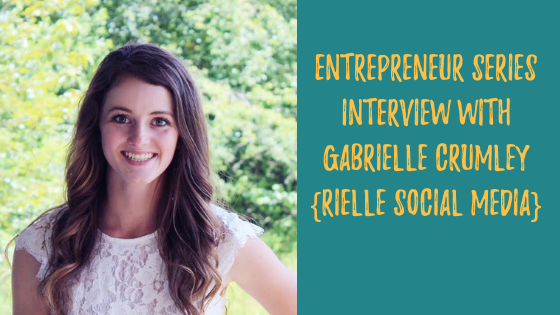
In this interview with Gabrielle, she had her heart and mind set on one direction in college, and little did she know after taking one marketing class, how her world would change. Sometimes you have to just trust your gut and take the leap of faith. Gabrielle has created a life around something she has found a passion for, allowing her to create the freedom and flexibility she was looking for. While still having a passion for animals her path has taken her in a different direction. Listen and see how.
More about Rielle Social Media
Gabrielle Crumley is the social media expert and digital marketing strategist behind Rielle Social Media.
I am passionate about helping business owners overcome their branding and social media challenges to see real success online.
Do you stress about what to post, or spending way too much money on ads that don’t convert? Whatever your specific business goals may be, I can help you achieve them. Learn more about her and her services at https://www.riellesocialmedia.com/
LinkedIn is, what I think one of the most overlooked social media platforms out there. A lot of business owners have a LinkedIn profile that they set up when they were back at their corporate job and maybe have updated it once or twice. Well, I am here to tell you WAKE UP and make sure you have updated your LinkedIn profile! In this blog we will be covering:
What you should include in your personal profile
How to create a company page
How you can add connections and build your network.
What Do I Need To Supply For A Linkedin Profile Page?
Top 9 things that you NEED to have in your profile
1. YOUR Picture
Do NOT use an avatar or cheesy image of yourself, people want to see YOU
You can use a current up-to-date headshot, or an image of yourself with a natural background, not a party or fuzzy image or a selfie. Take your time on this photo!
2. Headline and Header
Think of this as the first impression, this is what people are going to see with your name and picture.
Have your headline be intriguing, eye-grabbing, relevant and clear.
Include your company name and then your title or what you do.
You can now have a customized banner (1400×425), which you can create in Canva. This header should be relevant to who you are and what you do. Have fun with it.
3. Summary (Good for SEO)
Tell your story, what’s your WHY. Keep your summary in the first person.
Personalize your summary.
Your summary should be engaging, relevant and conversational.
In this area, it is great to demonstrate that you are an expert in your field/industry. Add media (Videos, PowerPoints, Presentations, PDFs. etc.)
Remember SEO when you are writing your summary. It is important to include your keywords in this section along with long-tail keyword phrases to have a higher rank within LinkedIn searches but also Google searches. Here are two pieces we did on finding your keywords so you know what you should be writing about. Finding Keywords and How to Use KWFinder.com
As I mentioned before add media to your summary! There is not a limit, I mean you don’t want to add your WHOLE YouTube Channel, but I would say between 2-5 videos, or maybe big presentations you have done, recorded webinars, things that give your audience value. Something they can learn from looking at your LinkedIn profile! AND this helps you stand out from everyone else. 🙂
We have spoken about what’s your WHY, creating that personal brand, your core values, brand message, you want to make sure those come through in your profile. People should be able to read your summary and understand who you are and WHY you do what you do.
Talk to your target market, at the end of your summary have a call-to-action
4. Experience
Start with the most recent position or company and give us details! What is your role, responsibilities, etc.
List the experiences you have had with each position or company
List our accomplishments and challenges you have encountered, what was the outcome?
Remember your target market and speak to them when you are adding your services and details.
You don’t need to list EVERY job you have had from the time you turned 15! Stay relevant list that last few with great detail.
5. Education
Where did you go to school? You can list high school and college
Remember to list your degrees, diplomas, certifications etc.
It’s important to also include dates and locations.
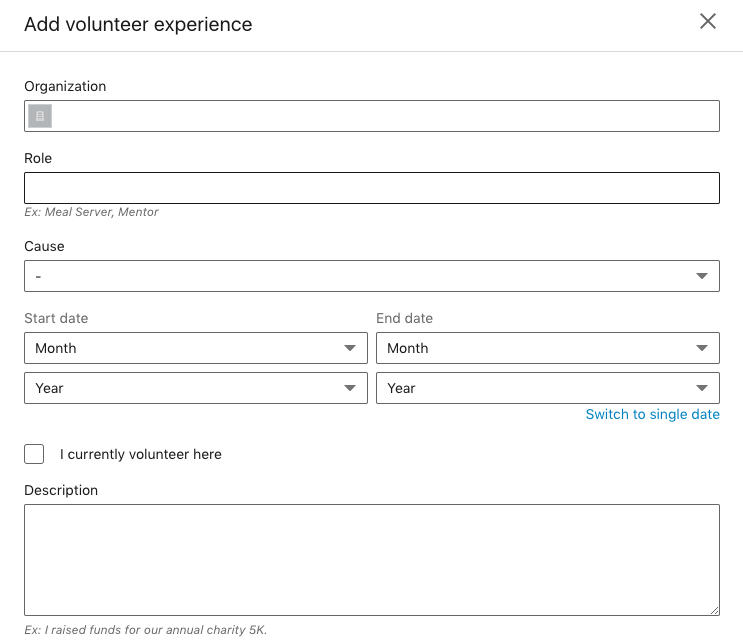
6. Volunteering & Causes
People LOVE to see that you are involved in your community or a certain cause. Cause marketing is HUGE!
List the non-profits you have helped, maybe sit on the board or have organized events for.
What causes do you donate your time, money and energy too?
7. Skills & Endorsements
We get asked this question a lot, should we include the skills and endorsements in our profiles? The answer is YES!
People have recognized you for a skill that you have, acknowledge it.
LinkedIn will have those endorsements show up by the ones people have selected the most. You can always go in and edit or delete these as you find needed.
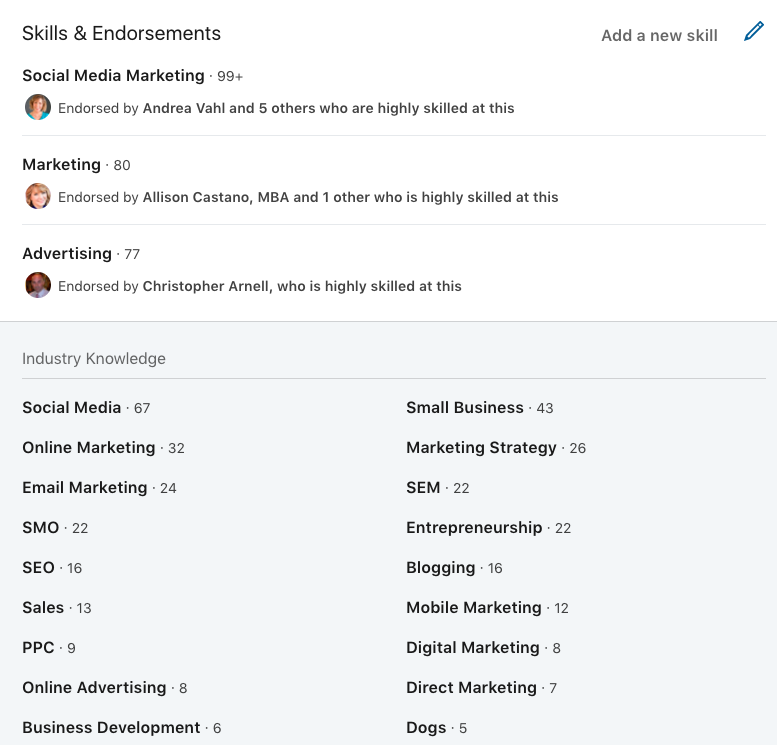
Think of your keywords when adding your skills, you will notice in the image below, the last skill on the bottom right corner says DOGS, um, I do social media and digital marketing, BUT in my past experience I was a Vet Tech at an Animal Emergency Center, so I may think of deleting that one just because it is not relevant with what I am doing now.
8. Recommendation & Awards
We always encourage our clients to have people give them recommendations on LinkedIn and include them in your profile.
List any awards you have won through work, community, networking.
9. Interests and Groups
As a bonus to your profile included interests you have
Also, include groups you are apart of on LinkedIn
Now, that we have your personal profile taken care of it is time to move into business. You can still post business related topics to your personal profile, but there are so many perks to having a business page on LinkedIn. In the video below I show you how to create that company page, so if you don’t have a company already take a minute to create one and then we will talk about “WHY” you need to have one and all the benefits!
LinkedIn Business Page
You want to make sure you optimize your company page to build brand recognition. We spoke last week about being consistent across the board with your social media and that remains the same with your company page. You want to make sure you have the right size header, logo, etc. Here are the sizes you need to have on your company page:
Company logo – 300 x 300
Cover image – 1536 x 768
Overview tab image – 360 x 120
Hero image – 1128 x 376
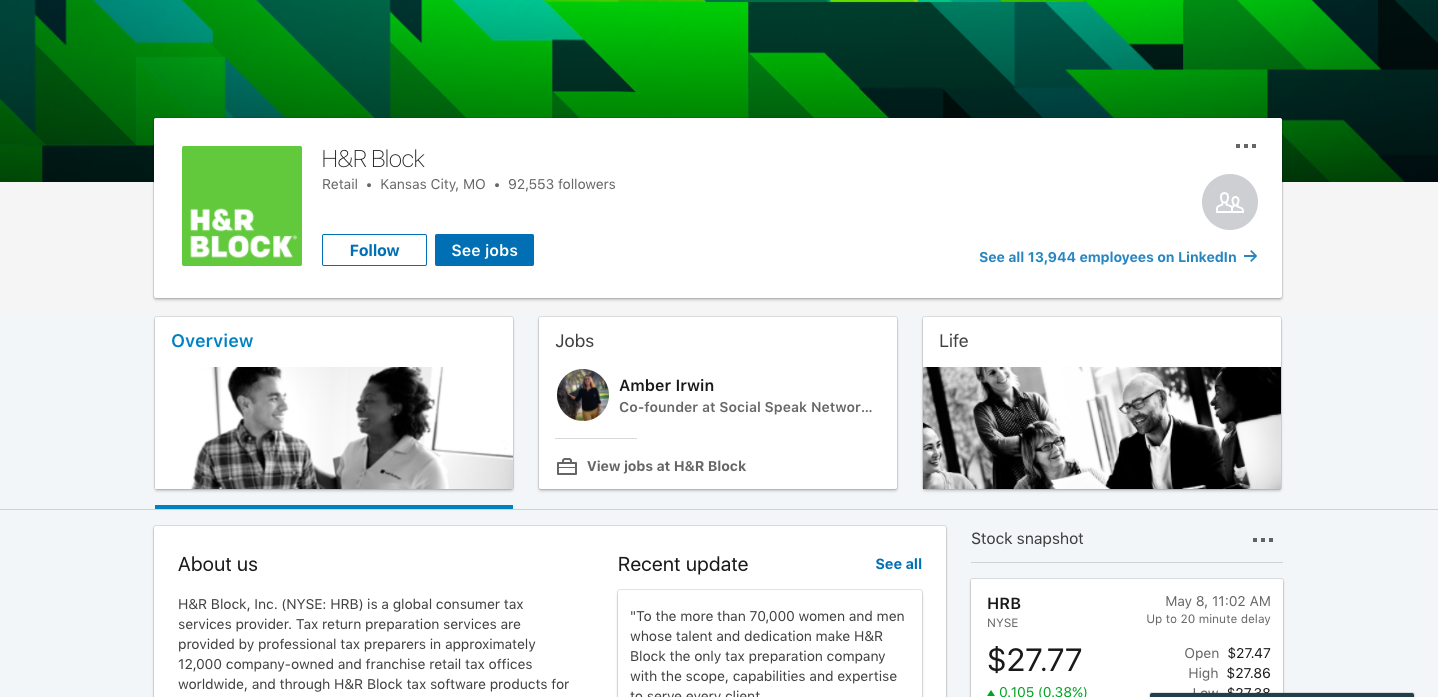
Here is an example of H&R Block’s company page, it is consistent with their brand, brand colors, logo, header, overview image, about us and more!
About Us Section
This is the MOST important piece of your company page, you have 2000 characters to use up. Think of your story, WHY your business does what it does, who do you help, speak to your target audience and use your keyword phrases. This is where your audience gets to really know WHO the company is. They are taking a peek inside and understand more of the foundation of your business. What makes your company stand out from the others, how did your company come to fruition, what is your business’s mission and vision, etc? More details the better. You want this section to be eye-grabbing and you want your audience to fall in love with your business, your brand, you want them to want to find out more. . . you want them walking away liking you, building that trust. You do not want them walking away feeling like they were being “sold” or not understanding what your business does.
Also remember in this section you want to add your website, your main office – with this piece most of our clients, including us work from our homes and do not want our address out to the world, I love coffee dates but don’t want people knocking on my door 🙂 You still need to enter your full address, but on the public page it will just say headquarters in CITY, ST not your address. In the video above I show how this process works! Also, you will enter the number of employees you have, the year you were founded, company type and BONUS – Specialties! You can use keywords in this area of specialties or a very clear short statement of what you do.
If you have LinkedIn upgrade package you can also add jobs and life section, we won’t really go into those today, just because most of our readers just use the free version of LinkedIn, just like us! The next thing we want to add as an extension of your company page is:
Add Showcase Pages
Creating a showcase page is adding to your company page, it is an extension. You can highlight a specific product or service your business offers. This allows your brand to come to life a little bit more. Before LinkedIn had a services/products tab, but they do not have that anymore. They now offer the showcase page/ It is an independent page with its own “About Us” section, logo, cover, website, etc. It also will have its own followers and you can post your own updates to this showcase page to show that service or products own personality. These updates you post would only be about this service or product. You can also monitor its own analytics, so you can see how that showcase page is doing.
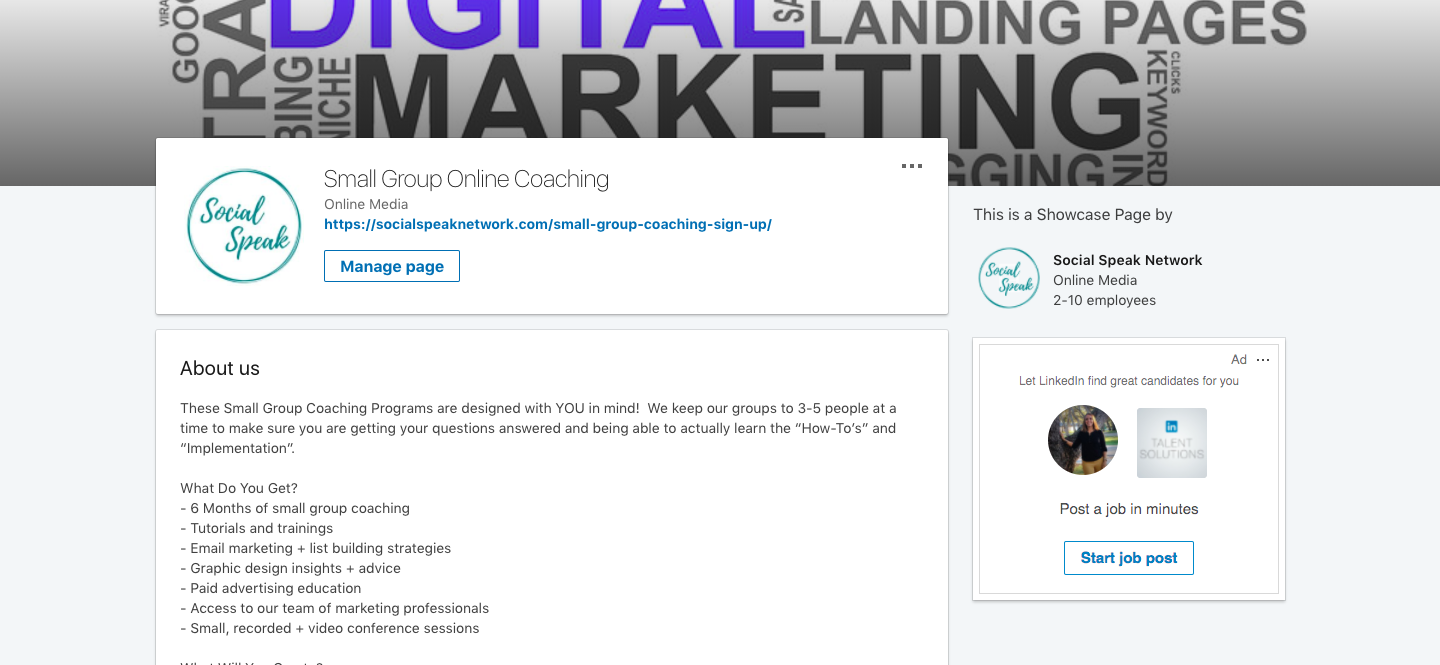
We created a showcase page just for our small group online coaching: As you can see this is just for our small group coaching and its website url is to that page on our website, then to the right you see that is says “This is a Showcase page by: Social Speak Network” which links back to our company page. This is a great way to talk about your key services or products. I would like 3-5, it adds so much value to your company page.
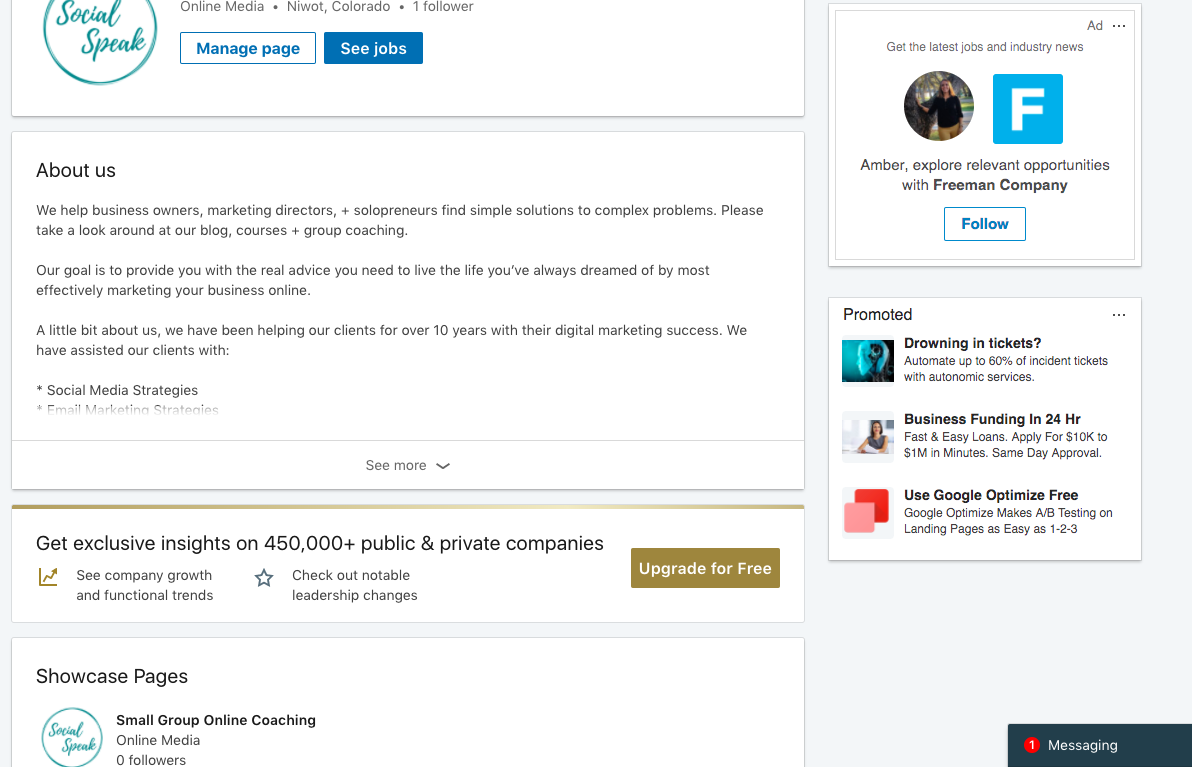
This is so freaking cool right?!?! Yes, it is! Now that you built your awesome Showcase pages I am sure you are wondering where does it show up and how do people see the connection between your company page and Showcase pages??? Well, it is pretty simple your Showcase pages show up right under (Well after the ads) the About Us section. This is just such a cool way to promote those key services or products. Think of these Showcase pages as website pages, they are meant to stay on your company page and be updated as needed. These are NOT pages to create events or short-term marketing offers or campaigns. These Showcase pages are going to help build trust and relationships with your audience. This is what is looks like:
Great job on getting your personal profile set up, your company page and showcase pages created, now it’s time to feed them! What I mean by this is CONTENT!
Start Posting Valuable Content:
Content stills remains a key component of these pages. If you took the time to create these pages, and make sure they look pretty and match your brans, why wouldn’t you want to do more with them? They need to be thought of the same as you think about your Instagram Business profiles or Facebook Page, you post to those daily or weekly correct? Your LinkedIn profile, Company Page, and Showcase pages should be thought of the same way! WOW, we just added a lot more to your list! Don’t worry you can add your company page and showcase pages to Buffer or Hootsuite, so you can schedule your posts to go out through one of these tools to help save time, but also to be consistent. You may need to upgrade your package with these two tools if you have already used the 3 free social profiles. Each of these is free to post through up to 3 profiles, so you may already have Facebook, Twitter, and your personal LinkedIn profile, you will need to increase your account so you can add more.
What are things you should talk about on each of these pages? I think we need to split these up into three different sections, each area such as your personal profile, company page, and showcase page will have their own personality. You need to treat them as their own entity. Each page audience will be different, they may be similar or you will have people that you are connected with on LinkedIn and YOU and then they follow your company page and maybe one of your showcase pages as well. So, they will NOT want to see the same content on each page. Let’s start with your personal profile first, this is what most people will see, because like all the social media algorithms you will get more engagement with your personal profile than your company pages.
Personal Profile Tips:
Post valuable content, NO political or religious posts
Post Daily
Share your businesses blog posts with clear call-to-action
Share your personal story
Stay away from posts you would put on your personal FB – LinkedIn is a little more professional
Share tips, techniques, tools, videos that align with your business
Talk about your role in your business, your journey, who you have helped, your WHY
Company Page Tips:
Post focused, clean, relevant, and valuable content
Share your blog posts
Talk about your content upgrades with call-to-action
Share your YouTube videos
Curated content – articles, videos, images from other companies that align with your business.
Feature an employee or a person that works with you
Behind the scenes – stories, pictures, videos
Test your audience – post an appropriate funny video or image and see the response, mix up your content to see what your audience is engaging with the most.
Branded images via Canva that have a quote or stat
Events – talk about local events that are going on or events you will be attending
Local – if you are a local business share local news
Speak to your target audience – ask them questions and get feedback
Showcase Page Tips:
This is about that one service or product
Stay focused on the topic at hand
Post maybe 3 times per week – people tht follow your company page or personal profile will already see what your business is doing so posts on your showcase page need to be specific to that service or product. You don’t want to overwhelm your audience.
Videos you have done on that service or product
Client testimonials
Share stories of your struggle, your journey or clients journey and how this service or product has helped them.
Share stats and success stories
As you can see these are all similar but different at the same time.
How to Grow your Profile and Company Page
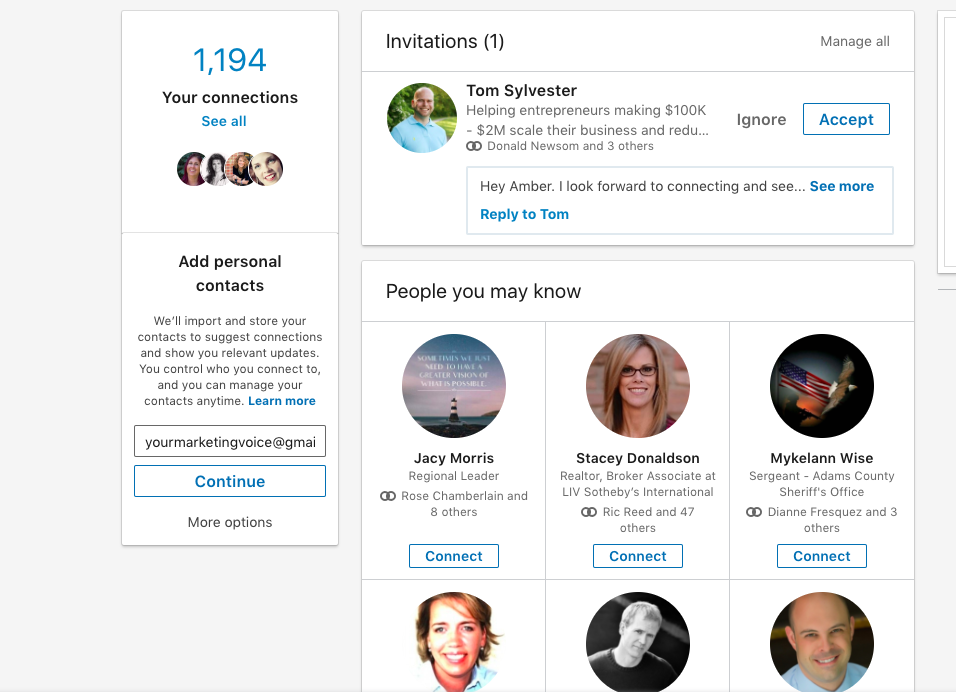
One of the features I like most about LinkedIn is you can add connections to grow your online community. Before, people would just add anyone and everyone so they built quantity connections, rather than quality. Yeah, it’s great to have a large number of connections but we want to focus on adding the quality connections. A key piece to adding quality connections is to have a little note, an intro when you ask somebody to connect with you if you don’ already know them. You may see LION next to peoples names, this stands for LinkedIn Open Networker, meaning they are open to connecting with everyone, I don’t see this being used too much anymore, which I like. You will get asked to connect with people you don’t know and that is OK, check them out, look at their profile and see who they are. I like to think of LinkedIn is an online networking group.
In this image below you will see that someone asked me to connect with him, I do not know him personally, but he did send a message along with the connection. LinkedIn will also show you “People you may know” similar to Facebook. These people show up based on your profile and mutual connections.
Here are a few ways to be able to connect or invite people to connect with people on LinkedIn:
If you know a specific name of the person you want to connect with, you can search for them and find their profile and then click connect.
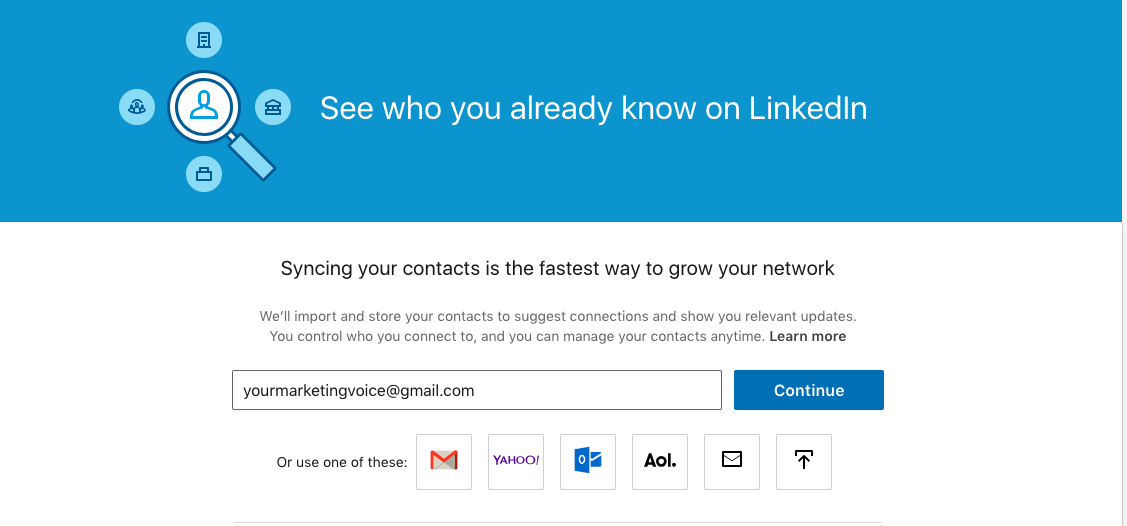
You can also upload your email list or contacts from Gmail, yahoo, outlook, etc.
Then as I mentioned above looking at the “People You May Know” section and asking people to connect through there.
NOTE: If people have asked to connect with you and you have pending invites they will appear on the top bar on your LinkedIn account next to “Network”
Again, we highly recommend before you go connection crazy that you craft together a short, simple to the point message of why you want to connect with that person and send it along when you ask to connect, let me show you:
What’s Next?
It is such a great feeling when you have your LinkedIn profile updated to 100% and then when you create your company page, Showcase pages and have started to add connections, but what will make people want to connect with you? CONTENT! Be sure to be consistent as we have spoken about. In our next blog, we will be talking about groups, article and how to prospect on LinkedIn to take your profile to the next level!
If you need some help setting up or company page or creating the right size graphic, please let us know!
Interested in learning more? Take a look at these articles:
As an entrepreneur, it is important to find tools to help us stay organized, creative and on top of our social media. In this video, we will go over 10 tools to help you save time, work smarter, not harder.
Interested in learning more? Take a look at the following videos:
Let’s talk Insights! If you are anything like me, you could care less about the analytics right? They are just numbers, what do they mean? I have always loved numbers, but analytics not so much. If you put those numbers and stats into a pretty infographic, then I am all over it! Since I have been a social media manager for almost 10 years, I have had to find that LOVE for analytics and be able to explain them in such a way where our clients get it! With Instagram busness profile, their insights ROCK! I get it! I would say it’s a mix of pretty pictures and hardcore data. I love the way it compiles the information to make it easy and understandable for you to read.
When Instagram Insights came out, I was not sure how much I trusted them. I remember when Facebook Insights were out and some of that data was wack! I mean for a few of our clients, it just didn’t make sense or even add up. I always said take Facebook Insights with a grain of salt. Now, with that being said they have come a long way and I think they learned a lot, so they were able to implement more pros into the Instagram Insights.
Instagram Insights:
These insights collect data for you that will help you learn more about your followers and audience. We started our Social Speak Network Instagram not even a year ago and we have some awesome insights to who our audience is, what days and times they are looking at our account, where they are located and much, much more!
Overview
First things first, you have to have a business Instagram account o get these AWESOME analytics. When you log into your account, on the top righthand corner you will see 4 lines, click there and this will take you to your insights.
From there the first thing you will see if your overview: this is going to show you your incease or decrease of followers from the week before and the reach from the week before. You want these number to always be in the +, if you see a – negatice or decrease we need to take a further look. Below your weekly numbers you then see your actions meaning how many people liked your posts that week. We had +19 actions in the past week. So, with all the posts we put up we had +19 actions meaning people liked our posts or made a comment.
Discovery
Ok, let’s discover something new! This area is all about discovery, just like it says. It is going to tell you where your post was seen and how many people it reached. This shows your reach and impressions. Your reach is the number of accounts you reached this week. Impressions are the number of times the media you created this week were seen. Your posts are discovered in particular places within Instagram such as a user’s home feed, a search someone did, your profile, your location or location tag and/or a hashtag you had used.
Demographics
This is where it gets exciting! You really get to see who your audience is. I love how Instagram has put together these insights.
The demographics on Instagram insights are great, they tell you the % of men and women that are engaging in your brand, the top locations, age range (which is key) also a HUGE nugget of information here is the days and times that people are engaging. So Monday early mornings may be one of your biggest days, whereas maybe Thursdays between 11-2 are not very good. You can play around with this and see what weeks, days, and times are best for you and your brand. Then create your strategy around those days and times to be sure to give that value back to your audience.
YAY, we have shown you all about Instagram Insights, now what do you do?
Download our Instagram Insights Tracker by clicking HERE
All aboard! It’s time to jump on the Instagram Stories Train. Did you know that Instagram Stories has over 800 million people that use this feature??? WOW! That is amazing. Below is a video that talks about the best ways to use Instagram Stories for your business.
Some tips to remember:
Have a plan for your stories – what are your goals when creating your stories
Use all the features that Instagram offers you, the stickers, colors, text, selfie sticker, location, as you use more of these options Instagram will push your story to more places
Try out the different features of stories to mix it up with Type, Live, Normal Picture or Video, Boomerang, Superzoom, Rewind, Hands-Free, and Stop-Motion
Build your brand through Instagram Stories
Stories only last for 24hours – be sure to share to Facebook Stories and as IG posts
Videos for Instagram Stories can be 15 seconds
Topics for Instagram Stories:
Talk about products or services you offer
FAQ
Being an expert in your field
Exclusive offers for your Instagram Followers
Signing up for FREE offer or newsletter
Behind the Scenes
Testimonials
Contests
New Blogs
Recipes
Podcasts
We would love to hear about your Instagram Stories Successes!
We have the basics set for Instagram, but now it is time to step up your game and create a cohesive strategy for your images and your Instagram feed. I wish I could say do X for a beautiful Instagram photo every time, but unfortunately, it all depends on your brand and the sentiment or feeling you are trying to evoke with your images.
In this post I’ll be exploring some of the ways to create an Instagram feed that you can be proud of! And, guess what? It all comes down to the images you plan to post.
Step 1: Make a List of the 3-5 things you/your business brand LOVES.
Common themes may be nature, organization, people, community, animals, sketches, etc. Think about what sentiment or feeling you get from these or that your brand wants to communicate.
Then think about the visual elements you are drawn to as they also relate to the sentiment of your brand.
For example, if you are a business coach and you value bringing clarity into your client’s lives and one of the things you are passionate about is organization, what other ways can you visually display this? What about crisp shadows and light filtering through architecture, or clean and clutter free office spaces.
Maybe your office values authenticity and personality. Would behind the scenes photos of office dogs capture a sense of playfulness?
In this stage, just brainstorm all the different types of things that encapsulate your brand, your passions, and the sentiment your want to convey.
Step 2: Find your color theme
By now you should have your brand colors selected, but if you don’t, that’s okay. Your Instagram can take on a slightly different color theme than your other marketing, as long as you are consistent.
To create a cohesive look for your Instagram photos, you need to always be thinking about the colors you are capturing in your images.
Which 2-3 colors do you want to bring into your color palette? I often enjoy feeds that are either vibrant with greens and colors found in nature or feeds that are crisp with whites and pops of color here and there. As you create your own ideas around colors, take a look at what some other popular accounts are doing below.
Once you have these colors, make sure to space them throughout your Instagram feed so you don’t have multiple photos in a row with the same color present.
Step 3: Use the same filter
One of my business partners is a photographer who emphasizes the need to edit photos before applying any filter. Personally, I think that is too much work for the average Instagram user, but I do agree that you should always be applying the same 1-2 filters in your posts so they all work well together.
However, as you you are taking the photos, pay attention to the natural light and backgrounds of your photos. Just being aware of what else is around can help you find consistency.
Step 4: Zoom in!
Sometimes on Instagram we try to pull too much into our images. Let’s say you are taking a picture of your office space for Instagram. Rather than trying to capture everything in one photo, zoom in on a single element. Not only will this make it easier to post more images of your office space, but you also will have a more visually appealing photo.
Sometimes I find that taking multiple photos at once can help keep the lighting consistent. So, pick a morning before your day gets busy and spend 30 minutes just taking photographs of small details within your office.
You aren’t going to publishing these all at once, but the simple zoomed in elements can provide a nice break within your Instagram feed.
Step 5: Always crop the same
Rather than trying to include both square and rectangular photos in your feed, it often is easier just to always crop your photos to square. There are some beautiful feeds which combine different photo orientations for a very playful feed, but for most of us, square works best.
Step 6: Create templates for any image with text overlay
We love utilizing Canva to create templates for any of those images where we share a quote or are announcing a sale, etc. Canva makes it easy to create that square image, incorporate your colors, and utilize your brand fonts.
Take a moment to think about what types of images you may want to use that will need a font overlay and how you would like the image to be displayed. Then, jump into canva and make a few variations of your designs that use different combinations of your brand colors. Below is an example for one of our clients.
Step 7: Don’t plan one image at a time, look at your entire Instagram feed
As you are compiling your posts for Instagram, I always recommend looking at how everything flows together. Apps like Later and the Preview App make it easy to visualize your entire Instagram feed rather than only one photo at a time.
Some common elements to consider are:
Tile Grid Layouts
Diagonal Grid Layouts
Row by row
Lines
Puzzles
As you can see, these take planning and sometimes if you are in a pinch, it is easier just to remember to rotate through your topics, your colors, and the various design elements of your photos 🙂
Step 8: Above all else, high quality photos win
As I’m sure you guessed, you always want to make sure you are using high quality photos for your Instagram feed. Some tips to remember as you are taking pictures:
If you use your phone for your images, the back camera is higher quality.
If you repost an image, use a reposting app rather than a screenshot. Better yet, reach out to the original photographer and ask if you can have the original photo to republish (and tag them in).
Quickly ‘enhance’ your photo on your phone with the built in photo editor.
Take multiple shots of the same item to ensure you use the one that is the most infocus with the best lighting.
The best times of day to take advantage of natural light are the mornings and the late afternoon. Here, the sun is still strong, but you won’t have such harsh shadows or bright spots in your images.
That’s it! Have fun with your Instagram photos and try to view your entire feed as an ever changing piece of art rather than each block as an individual element.
Please note, all images of Instagram Feeds are taken from The Preview App.
https://socialspeaknetwork.com/wp-content/uploads/2018/03/Instagram-images.png315560Caitlin McDonaldhttps://socialspeaknetwork.com/wp-content/uploads/2018/04/SocialSpeak-Logo.pngCaitlin McDonald2018-03-20 17:36:182018-03-20 17:40:51Step up your Instagram Game - What makes a good image (or feed)?
Now, that you have your Instagram Business account set up, and ready to rock and roll, right? We have spoken about the importance of having the business Instagram account, all the data it gives you and how it can help you define your target market. So, what now? It’s time to start posting! Before you just jump right into posting anything, it’s important to have a plan. What topics do you want to talk about on Instagram, what’s the story you want to tell? What value do you want to give your audience?
You now know what you will be talking about each day, you can start looking for images on Pixabay or Pexels or even better take your own. Have the topic, image and post put together, you can even put the hashtags you want to use in each post. There are a few tools that we love to use to organize your Instagram posts:
These all help you organize your Instagram posts. Hootsuite, Buffer and Later, you can actually schedule your posts to your business Instagram account. Although this is great on time-management, we still highly recommend posting manually. If you are posting 7 days a week maybe you can schedule 3-4 posts per week and manually post the others. You still want to engage with your audience, follow people, comment and share posts. It can be easy to get comfortable with these awesome scheduling tools you forget that Instagram is a 2-way street.
If you have set up an Instagram account and have not yet converted it over to a business account, don’t wait any longer! You are missing out on a TON of data! There are not a lot of differences between your personal Instagram and Business Instagram as far as looks go, BUT the key to the business Instagram is that you get to really know who your audience is. The insights of your business account will really let you know who is engaging with your brand. It will tell you age, gender, location and more!
By switching to a business account you will have the ability to:
* Run ads and promotions
* Link to your Facebook business page, Twitter, and Tumblr accounts
* View Insights
https://socialspeaknetwork.com/wp-content/uploads/2018/03/Biz-IG.png7201280Amber Irwinhttps://socialspeaknetwork.com/wp-content/uploads/2018/04/SocialSpeak-Logo.pngAmber Irwin2018-03-09 00:49:372018-04-04 02:46:45How to convert your Instagram into a Business account